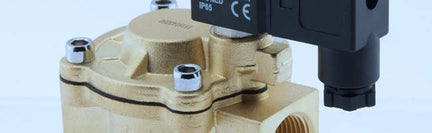



Collection:3-Way Solenoid Valves
A 3-way solenoid valve, also called a 3/2-way or 3-port solenoid valve, has 3 ports and 2 switching positions. It switches the flow between 2 lines, or it connects 1 line alternately to a supply... Read more


3-Way Solenoid Valves

A 3-way solenoid valve, also called a 3/2-way or 3-port solenoid valve, has 3 ports and 2 switching positions. It switches the flow between 2 lines, or it connects 1 line alternately to a supply and an exhaust. All 3/2-way solenoid valves in the range are direct-acting, so they also work without pressure difference. Choose the valve by function, housing material, and seal.
Ports and functions
For NC and NO valves, the ports are: inlet P (1), outlet A (2), and exhaust or return R (3).
- Normally closed (NC): without power, the inlet is closed and the outlet is connected to the exhaust. With power, the inlet is connected to the outlet.
- Normally open (NO): without power, the inlet is connected to the outlet. With power, the inlet is closed and the outlet is connected to the exhaust.
- Diverting: 1 inlet and 2 outlets. The valve sends the flow to one outlet or to the other.
- Mixing: 2 inlets and 1 outlet. The valve selects one of the 2 media. It does not blend them.
- Universal: each port can be the inlet, so 1 valve can operate as NC, NO, diverting, or mixing.
Choosing a 3/2-way solenoid valve
- Flow rate: the small orifice of a direct-acting valve limits the flow rate. Compare the Kv or Cv value of the valves.
- Pressure: a smaller orifice permits a higher maximum pressure. Thus a high pressure and a high flow rate in 1 valve are often not possible. On an NC or NO valve, connect the pressure only to the inlet.
- Seal: FKM for compressed air, oil, and fuel. EPDM for water and hot water. NBR for cold water, compressed air, and oil.
- Coil: choose the supply voltage, AC or DC, and for AC the supply frequency (50 or 60 Hz).
- Dirt: the small orifices block easily. Install a strainer before the valve.
- Pneumatic cylinders: for a cylinder on compressed air, a pneumatic solenoid valve (3/2 or 5/2) is usually the better choice.
Housing material
- Brass: the most common choice, for water, compressed air, oil, and neutral gases.
- Stainless steel: for corrosive media and corrosive surroundings, usually in 316 grade.
- Plastic: for aggressive media, often in analysers and dosing systems. The housing and the seal must both resist the exact medium.
Special versions
The filters show all special versions. The most common are:
- Manual override: a technician can switch the valve without power to the coil, for example during commissioning. It is an override, not a hand-operated valve.
- Media separation: a diaphragm separates the medium from the plunger and the plunger tube. This is for aggressive or high-purity media, for example in laboratory equipment and analysers.